Mobile Business /
Unity Spark Expands AI Game Creation With Google Playground Integration
Unity Spark pairs natural language prompts and Asset Store tools with Google Playground to simplify prototype game creation and distribution.
Key facts
- Topic:
- Mobile Business
- Published:
- 2026-10-09
- Reported by:
- Gameforce Mobile News Desk
Key takeaways
- Unity Spark enables text-prompt game creation with a browser-based refinement editor.
- Integrates professional Unity Asset Store resources rather than relying only on AI generation.
- Partners with Google Playground for simplified web and mobile game distribution.
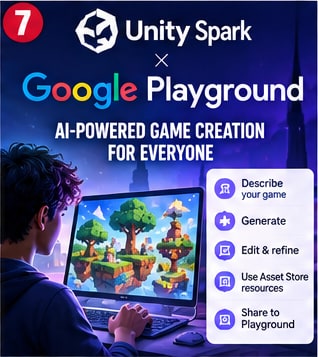
Unity has revealed additional details about Unity Spark, a new AI-assisted game creation platform designed to help users develop interactive experiences without traditional programming. The system allows creators to describe game ideas through text prompts and refine the results using a browser-based editor. Unlike tools that simply generate basic code and leave users to discover what went wrong, Spark is intended to support a more complete development workflow.
It also integrates artist-created resources from the Unity Asset Store, allowing creators to work with existing production assets rather than relying entirely on automatically generated visual material. Unity has confirmed a partnership with Google that will eventually connect Spark to the newly introduced Playground platform, enabling creators to distribute more sophisticated browser-based games. Spark is currently approaching a closed beta, with a waitlist available for interested developers.
The announcement is particularly relevant to mobile gaming because the technical barriers to creating simple games have historically been substantial. Smaller teams may eventually be able to prototype ideas much faster and spend more time refining gameplay. However, producing something that technically functions is not the same as creating an enjoyable commercial game. Balancing difficulty, designing compelling levels, building coherent artwork and testing hundreds of interactions remain substantial challenges.
AI may reduce the amount of time required to construct a prototype, but it cannot automatically guarantee that players will enjoy the result. Otherwise, the world's greatest game designers would simply be the people who type the longest prompts.