Mobile Industry /
Gaming Acquisitions Reach $2.4 Billion in Third Quarter as Mobile Studios and AI Tools Attract Investors
Drake Star's Q3 2026 report shows $2.4 billion in gaming mergers and acquisitions, led by Lingxi Games' $1.5B sale and heavy venture concentration in AI tech.
Key facts
- Topic:
- Mobile Industry
- Published:
- 2026-10-15
- Reported by:
- Gameforce Mobile News Desk
Key takeaways
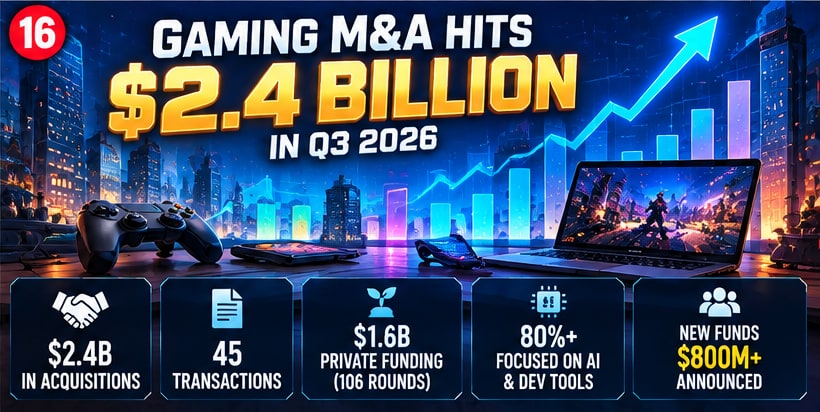
- Total M&A volume hit $2.4 billion across 45 transactions in Q3 2026.
- Alibaba's $1.5B sale of Lingxi Games to Trustar Capital represented the largest single deal.
- Over 80% of $1.6B in private investments concentrated in AI and development tech.
A newly published report from investment bank Drake Star Partners reveals that the global gaming industry recorded approximately $2.4 billion in mergers and acquisitions across 45 transactions during the third quarter of 2026. The findings were reported on October 14 and provide an interesting picture of investor priorities as the industry approaches the end of the year. Private financing exceeded $1.
6 billion across 106 funding rounds, with artificial intelligence and development tools accounting for more than eighty percent of the reported private investment. The largest acquisition involved Alibaba's sale of Lingxi Games to Trustar Capital for more than $1.5 billion. Other notable transactions included the sale of mobile chess and card developer Xianlai Interactive Entertainment for approximately $105 million, and Tripledot Studios' acquisition of Supersonic from Unity.
The report also identified substantial investment in technology companies supporting game development, artificial intelligence and digital content production. Major funding rounds included $400 million for Meshy and $220 million for General Intuition. Eight new gaming investment funds were announced during the quarter, representing more than $800 million in potential capital.
The findings suggest that investors remain interested in gaming businesses with established audiences, valuable intellectual property and scalable technology. However, the concentration of financing in AI-related companies also indicates that conventional game studios face increasingly intense competition for investment. For mobile developers, the report offers both encouragement and a warning.
Commercially successful games and useful development technologies can still attract substantial capital, but investors appear increasingly selective. Apparently creating an entertaining game is no longer enough. Developers must also demonstrate that their business model can survive an investment committee armed with spreadsheets.