Gaming Phones /
Retro Remake Reveals SuperStation Pocket FPGA Handheld With Original Game Boy Cartridge Support
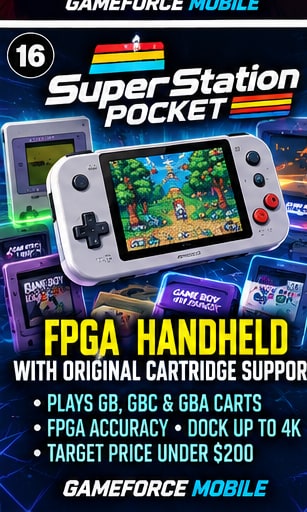
Retro hardware maker Retro Remake reveals the SuperStation Pocket, an FPGA handheld directed by Taki Udon featuring physical Game Boy cartridge slots and a 4K dock for under $200.
Key facts
- Topic:
- Gaming Phones
- Published:
- 2026-10-29
- Reported by:
- Gameforce Mobile News Desk
Key takeaways
- SuperStation Pocket FPGA handheld announced by Retro Remake under the direction of Taki Udon.
- Supports physical Game Boy, Game Boy Color, and Game Boy Advance cartridges with hardware-level accuracy.
- Targets sub-$200 pricing, 4K docking output, four face buttons, and PS1/N64 era FPGA capabilities.
Retro gaming hardware company Retro Remake has revealed its first FPGA-based handheld, the SuperStation Pocket, promising an unusually ambitious combination of original cartridge compatibility and advanced hardware recreation. The announcement appeared on October 28 and was not included in the previous edition, making this a catch-up report on a significant handheld development.
The device is being developed under the direction of retro hardware enthusiast Taki Udon and is designed to support original Game Boy, Game Boy Color and Game Boy Advance cartridges. Unlike conventional software emulation devices, FPGA systems use configurable hardware to reproduce the behaviour of older gaming platforms. Supporters argue that this approach can provide particularly accurate timing and low input latency, although actual performance depends on the quality of individual hardware implementations.
Retro Remake claims the SuperStation Pocket will feature a sufficiently powerful FPGA to support systems extending into the PlayStation and Nintendo 64 generations. The company is also developing an affordable docking accessory capable of delivering video output at resolutions up to 4K. Four face buttons are planned to improve compatibility with systems requiring additional controls.
The manufacturer has indicated a target price below $200, positioning the device against premium retro handhelds and existing FPGA alternatives. However, complete specifications, independent performance testing and a confirmed release date remain unavailable. Those details will be important before buyers can determine whether the device delivers on its ambitious promises. Nevertheless, the announcement suggests that FPGA technology is becoming increasingly accessible to portable gaming enthusiasts.
Apparently the retro handheld market has decided that merely playing thirty-year-old games is no longer enough. It now wants to recreate the original hardware while fitting everything into a pocket.