Mobile Updates /
Azahar 2127.1 Release Candidate Addresses Nintendo 3DS Emulation Performance and Android Stability Problems
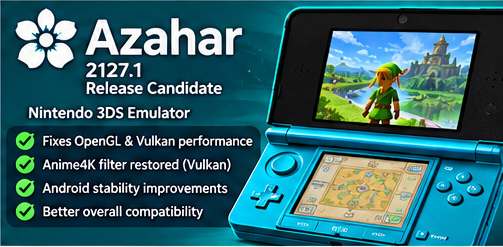
Published on GitHub on November 27, the Azahar 2127.1 Release Candidate resolves OpenGL and Vulkan rendering regressions, restores the Anime4K filter under Vulkan, and fixes Android touch-control layout and background-resume crashes.
Key facts
- Topic:
- Mobile Updates
- Published:
- 2026-11-28
- Reported by:
- Gameforce Mobile News Desk
Key takeaways
- Azahar 2127.1 Release Candidate is out on GitHub with OpenGL regression and Vulkan duplicate-frame fixes.
- The Anime4K texture filter is restored under Vulkan alongside configuration and DLC compatibility updates.
- Android fixes address fresh-install touch-control positioning and crashes when resuming from the background.
The development team behind Azahar has published the first release candidate for version 2127.1, introducing a collection of improvements intended to resolve performance and stability problems affecting the Nintendo 3DS emulator. Released on GitHub on November 27, the update addresses an earlier rendering regression that particularly affected OpenGL performance, alongside a separate Vulkan-related performance issue involving duplicate-frame handling.
The Anime4K texture filter is also available again under Vulkan following corrective work. Android users receive several platform-specific improvements, including a fix for incorrectly positioned touchscreen controls on fresh installations and a crash that could occur when reopening the application after it had been placed in the background. Additional changes address configuration handling and compatibility with certain downloadable game content.
These improvements are particularly relevant to the growing number of Android gaming handhelds designed to provide portable access to classic software. Emulation performance depends on considerably more than the specifications printed on a hardware manufacturer's packaging, and improvements to rendering efficiency can sometimes make an existing device more useful without requiring consumers to purchase another machine.
The developers emphasise that this version remains a release candidate rather than a fully stable update. Users are advised to back up their existing data before testing it, while those who prefer dependable everyday performance may wish to wait for the final release. The continuing development of Azahar is another reminder that retro gaming sometimes involves remarkably modern engineering. Unfortunately, even the most nostalgic video games cannot entirely escape the occasional software bug.