Hardware /
MediaTek Dimensity 9600 Pro Brings 2nm Competition to Flagship Android
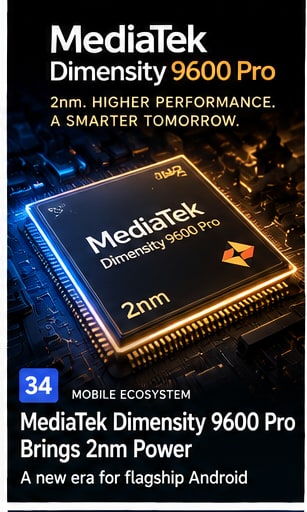
MediaTek has unveiled the Dimensity 9600 Pro, moving the flagship Android processor battle into the 2nm manufacturing era.
Key facts
- Topic:
- Hardware
- Published:
- 2026-09-19
- Reported by:
- Gameforce Mobile News Desk
Key takeaways
- MediaTek has unveiled the Dimensity 9600 Pro, moving the flagship Android processor battle into the 2nm manufacturing era.
- Built using TSMC's 2nm process, the chip is positioned around improved performance, greater power efficiency and more capable on-device AI processing.
- Actual gaming performance will depend on cooling systems, drivers and individual handset tuning, so the first retail devices will be more informative than synthetic benchmark claims alone.
MediaTek has unveiled the Dimensity 9600 Pro, moving the flagship Android processor battle into the 2nm manufacturing era. Built using TSMC's 2nm process, the chip is positioned around improved performance, greater power efficiency and more capable on-device AI processing. Those improvements matter particularly for mobile gaming because sustained performance is constrained as much by heat and battery consumption as by raw benchmark speed.
A smaller manufacturing process does not automatically guarantee cooler phones, but it gives device makers more room to balance frequency, efficiency and thermal limits. MediaTek's timing is also strategically important, arriving as Qualcomm prepares its next Snapdragon flagship generation and manufacturers plan their late-2026 and 2027 premium devices.
For years, Snapdragon chips were treated as the default choice for enthusiast Android gaming, but Dimensity has increasingly challenged that assumption at the high end. The 9600 Pro gives phone makers another serious platform for devices that need console-like graphics, high-refresh displays and increasingly complex local AI workloads.
Actual gaming performance will depend on cooling systems, drivers and individual handset tuning, so the first retail devices will be more informative than synthetic benchmark claims alone.