Hardware & Retro /
Qualcomm opens Adreno Neural Fusion SDK to make AI-generated pixels part of everyday mobile gaming
Qualcomm has detailed its Adreno Neural Fusion SDK, giving developers tools to use AI-assisted graphics techniques on the company's latest Snapdragon hardware.
Key facts
- Topic:
- Hardware & Retro
- Published:
- 2026-09-23
- Reported by:
- Gameforce Mobile News Desk
Key takeaways
- Qualcomm has detailed its Adreno Neural Fusion SDK, giving developers tools to use AI-assisted graphics techniques on the company's latest Snapdragon hardware.
- That sentence will make graphics engineers nod thoughtfully and everybody else wonder which frames technically exist.
- Future flagship gaming battles will increasingly be about which chip reconstructs, predicts and synthesizes imagery most convincingly, not simply which one can calculate the most raw pixels.
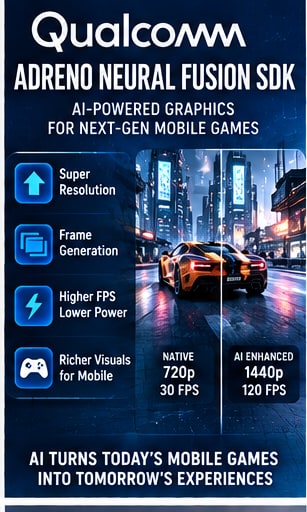
Qualcomm has detailed its Adreno Neural Fusion SDK, giving developers tools to use AI-assisted graphics techniques on the company's latest Snapdragon hardware. Two of the headline features are Super Resolution and Frame Generation. Super Resolution allows a game to render internally at a lower resolution and reconstruct a higher-resolution output, reducing the work performed by the GPU.
Frame Generation can synthesize intermediate frames between conventionally rendered ones, raising perceived frame rate without demanding that the game engine calculate every displayed frame from scratch. Used together, Qualcomm says developers can render at roughly half resolution and submit fewer native frames while still producing a high-resolution, higher-frame-rate final image. That sentence will make graphics engineers nod thoughtfully and everybody else wonder which frames technically exist.
The important point is efficiency. Smartphones operate inside much tighter thermal and battery limits than desktop graphics cards, so AI reconstruction could let developers deliver richer visuals without immediately turning premium phones into expensive hand warmers. Qualcomm's SDK announcement also shows mobile graphics moving decisively beyond traditional raster-performance comparisons.
Future flagship gaming battles will increasingly be about which chip reconstructs, predicts and synthesizes imagery most convincingly, not simply which one can calculate the most raw pixels.