Hardware & Retro /
Apple's A20 Pro reportedly runs a 27-billion-parameter AI model locally at twice A19 Pro speed
A new demonstration involving Apple's A20 Pro processor has shown just how quickly smartphone-class local AI is expanding.
Key facts
- Topic:
- Hardware & Retro
- Published:
- 2026-09-23
- Reported by:
- Gameforce Mobile News Desk
Key takeaways
- A new demonstration involving Apple's A20 Pro processor has shown just how quickly smartphone-class local AI is expanding.
- The result is not a conventional gaming benchmark, but the technology is highly relevant to future mobile games.
- Still, the demonstration provides another indication that the processors shipping in premium phones are becoming general-purpose computational platforms rather than chips concerned primarily with apps, cameras and conventional graphics.
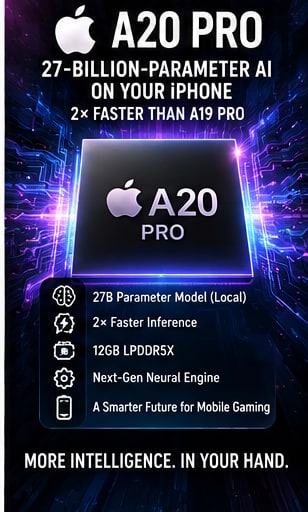
A new demonstration involving Apple's A20 Pro processor has shown just how quickly smartphone-class local AI is expanding. Reporting today says an iPhone 18 Pro running the Bonsai 27B model delivered roughly twice the local inference performance achieved with last year's A19 Pro. The model contains around 27 billion parameters and uses heavy quantisation to make an otherwise enormous workload practical within a phone's memory limits.
Apple's latest Pro hardware combines its updated Neural Engine with 12GB of LPDDR5X memory and significantly increased memory bandwidth, both important when moving large AI models locally rather than relying on cloud servers. The result is not a conventional gaming benchmark, but the technology is highly relevant to future mobile games.
Larger local models could eventually power richer NPC dialogue, procedural assistance, translation, accessibility features and AI-driven content without requiring every interaction to travel across the internet. There are still severe memory, power and thermal limitations, of course; nobody should expect an entire cloud datacentre to crawl into an iPhone before Christmas.
Still, the demonstration provides another indication that the processors shipping in premium phones are becoming general-purpose computational platforms rather than chips concerned primarily with apps, cameras and conventional graphics.