Mobile Games /
Orisuji Turns the iPhone Duo Folding Screen Into a Puzzle Mechanic Across 69 Levels
Innovative papercraft puzzler Orisuji launches October 23 on iOS, using the folding hinge of the iPhone Duo as a primary gameplay mechanic.
Key facts
- Topic:
- Mobile Games
- Published:
- 2026-10-17
- Reported by:
- Gameforce Mobile News Desk
Key takeaways
- Uses the physical folding hinge of the iPhone Duo to connect pathways and manipulate paper mazes.
- Includes 69 levels across six themed worlds, fully playable on standard iPhones via touch gestures.
- Premium $4.99 release on October 23 with no advertisements or in-app purchases.
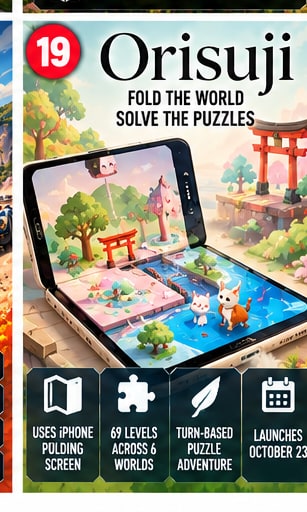
Orisuji is preparing to launch on iOS on October 23, introducing a puzzle game designed to take advantage of Apple's foldable iPhone Duo while remaining playable on conventional iPhones and iPads. The game presents its environments as illustrated paper mazes arranged across two pages. Players manipulate those pages to connect pathways, transport characters and solve increasingly complicated spatial challenges. On the iPhone Duo, physically folding the device changes how the maze behaves.
The left page can overlap the right, creating temporary pathways or trapping objects beneath the folded surface. Opening the device again changes the arrangement, potentially carrying characters to new positions. Players using conventional devices can reproduce the same actions through touchscreen gestures. Orisuji contains 69 levels distributed across six themed worlds, each featuring its own paper designs and music.
Challenges involve guiding animals, collecting keys, opening doors and manipulating environmental elements that appear or disappear depending on the arrangement of the pages. The game is turn-based and does not impose time limits, allowing players to consider solutions at their own pace. Completing puzzles efficiently provides additional collection objectives. Orisuji will cost approximately $4.99 and does not include advertising or in-app purchases.
Its most interesting characteristic is the way it treats a device's physical design as part of the gameplay rather than simply providing a larger display. Foldable smartphones have frequently been marketed around productivity and multitasking, but experimental games could provide another reason to consider the format. Apparently the future of mobile puzzles involves rediscovering the ancient art of folding a piece of paper correctly.