Industry /
Sega Sammy Reports Free-to-Play Revenue Decline as Publisher Focuses on Existing Mobile Games
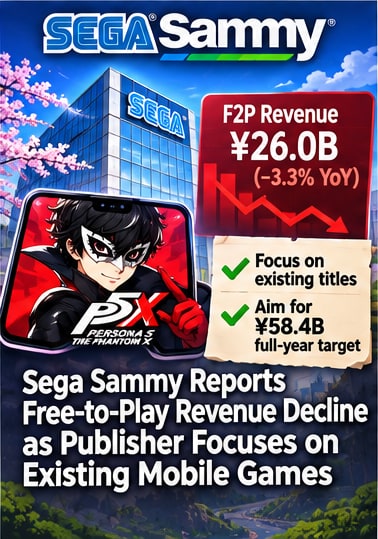
Sega Sammy records a 3.3% year-on-year drop in free-to-play mobile earnings to 26 billion yen, shifting strategic focus toward live-service live ops to meet full-year targets.
Key facts
- Topic:
- Industry
- Published:
- 2026-11-07
- Reported by:
- Gameforce Mobile News Desk
Key takeaways
- F2P gaming revenue fell 3.3% year-on-year to approximately 26 billion yen for the half-year ending Sept 2026.
- Prior-year comparisons were elevated by the strong launch performance of Persona 5: The Phantom X.
- Sega Sammy is prioritizing live ops and player retention on existing titles to reach its ¥58.4B annual goal.
Sega Sammy Holdings has reported a decline in revenue from its free-to-play gaming business during the six months ending September 2026. According to financial information published by Japanese industry outlet gamebiz on November 6, the operation generated approximately 26 billion yen, representing a 3.3 percent decrease compared with the corresponding period a year earlier.
The previous year's performance benefited from the release of Persona 5: The Phantom X, which contributed to stronger revenue during the comparable quarter. Sega Sammy's latest figures indicate that free-to-play revenue also came in slightly below management expectations. Rather than depending exclusively on another major launch, the company intends to strengthen the performance of existing titles as it works toward its full-year revenue objective of 58.4 billion yen.
That strategy reflects an increasingly important reality in mobile gaming. Acquiring players can be expensive, while keeping an established audience engaged through events, content updates and improvements to progression systems can provide a more sustainable commercial foundation. Nevertheless, maintaining mature games presents its own challenges because players have enormous numbers of competing entertainment options.
The results also illustrate the danger of comparing individual financial periods without considering the timing of product launches and major promotional events. A particularly successful character campaign or new game can produce temporary revenue increases that are difficult to repeat. Apparently maintaining a successful free-to-play business resembles running a long-running television series: the audience must keep returning, the characters need interesting stories and somebody has to finance the next season.