iOS/Android /
SPACE SWOOSH
In Space, Nobody Can Hear You Blame Your Thumb.
Reviewed by Marcus Vane for Gameforce Mobile
Game overview
- Platform:
- iOS/Android
- Developer:
- Vlad-Constantin Tudose
- Publisher:
- Vlad-Constantin Tudose
- Monetization:
- Free + In-App Purchases
- Review date:
- Oct 6, 2026
Final Score: 80%
- Sound: 78%
- Graphics: 80%
- Gameplay: 82%
- Fun Factor: 80%
Scores follow the Gameforce Mobile 100-point scale: 90+ exceptional, 80-89 great, 70-79 good, 60-69 average. How our review scores work.
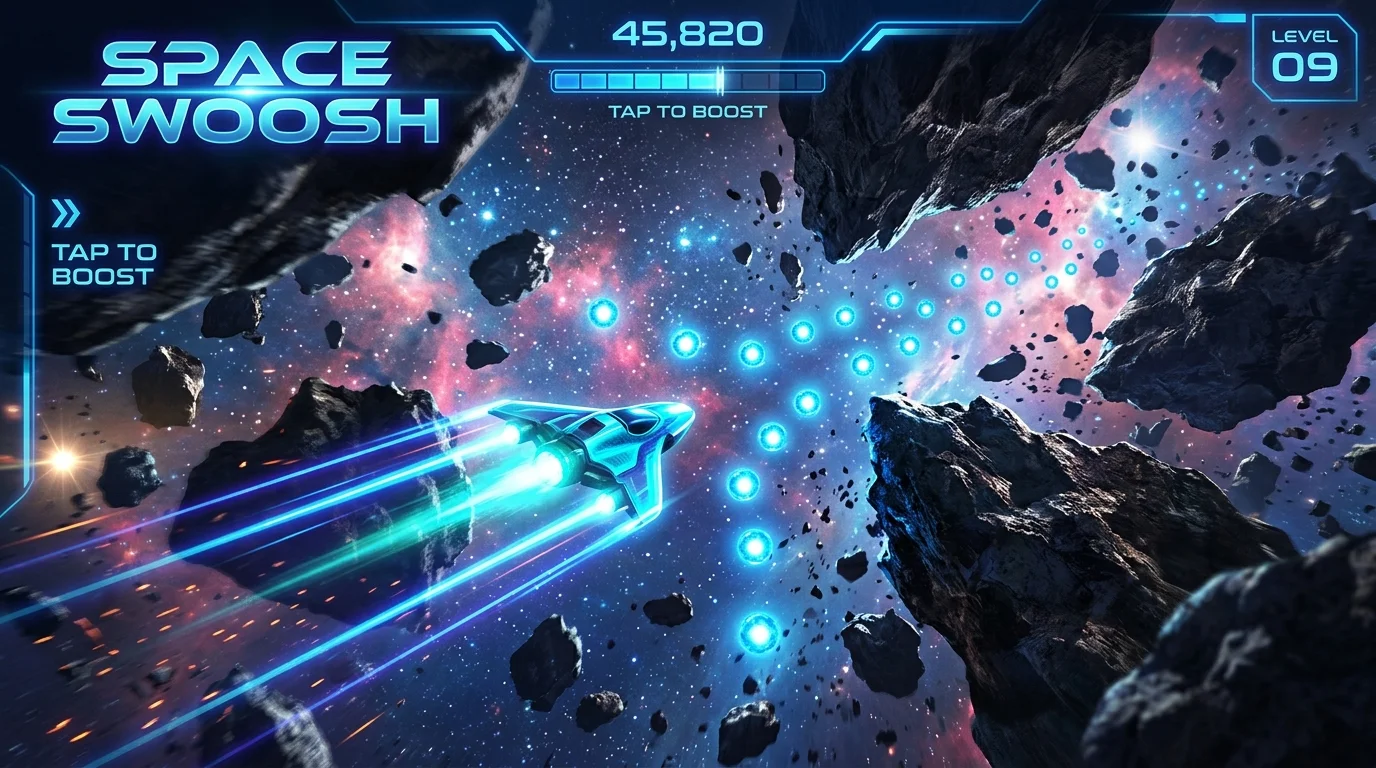
A tiny spaceship, one thumb, a suspicious number of asteroids and the eternal belief that this run will definitely go better. Space Swoosh understands mobile arcade gaming rather well.
There is something wonderfully suspicious about a mobile game that can explain its controls before you have finished unlocking your phone. Space Swoosh is essentially a one-thumb arcade flyer: your little spacecraft hurtles forward, you steer, you collect blue fuel, you squeeze through gaps and you attempt not to convert several million dollars' worth of imaginary spacecraft into interstellar confetti.
That sounds simple because it is simple. Thankfully, simple and stupid are not the same thing.
Space Swoosh belongs to that increasingly rare category of mobile games that apparently does not require you to complete an undergraduate degree in currencies, crafting materials, daily reward calendars and seventeen different varieties of purple gemstone before you're allowed to have fun. You fly. Space tries to kill you. You try to explain to space that you have other plans.
Space generally wins.
The central idea is built around constant forward motion and minimal steering. Fuel comes from collecting blue objects, while shields let you temporarily treat incoming rocks with the contempt normally reserved for speed bumps in a rental car. There are portals, black holes and narrow passages, and slipping particularly closely through a gap triggers the game's titular “Swoosh.” The official listings describe 39 ships, a Space Log and collectible stars alongside the basic flight mechanics.
The important part is that the design makes sense on a phone. There is no attempt to squeeze a PlayStation controller onto six inches of glass. Your thumb does the work, your eyes stay on the approaching hazards and your dignity gradually disappears as you realise that the gap you confidently aimed for was approximately three pixels narrower than your spacecraft.
More Than an Endless Runner With a Rocket
The pleasant surprise is that developer Vlad-Constantin Tudose has put more structure around the idea than the initial elevator pitch suggests.
There are essentially two ways to play. Open Space is the arcade-purist version: keep flying until physics files the inevitable paperwork. Scores feed into a Space Board leaderboard, giving the familiar “one more go” loop some competitive purpose. The Android version has also recently added friend leaderboards, while an update dated September 20 addressed high-score submission, difficulty balance and Journey progression.
Then there is Journey, which is considerably more interesting. It stretches across 42 days and introduces NAV, a voice guiding your tiny ship toward the origin of a broken signal. Story arrives gradually rather than stopping the game every four minutes so two anime characters can discuss the fate of civilization for seventeen text boxes. That restraint suits Space Swoosh rather well.
It also gives the game something many endless-score chasers never quite manage: a reason to wonder what happens next.
There is a surprisingly melancholy little science-fiction idea hiding underneath the reflex game. You're flying through an enormous empty universe because somebody, somewhere, once tried desperately to be heard. That is considerably more atmospheric than “Space Level 7: now the rocks are faster.”
It doesn't suddenly make Space Swoosh Mass Effect, obviously. Commander Shepard is unlikely to lose sleep over the competition. But giving a mechanically simple arcade game a little mystery and personality is a good decision, and it stops the whole affair feeling like something designed exclusively to occupy the three minutes between ordering coffee and receiving coffee.
The Problem With Simplicity Is… Simplicity
The game's strength is also where our biggest reservation sits.
The basic loop is deliberately narrow. Steer, collect, avoid, squeeze through, survive. When the speed and obstacle density climb, that can become deliciously stressful, particularly because arcade games are at their best when failure feels approximately 98% like your own fault and 2% like an international conspiracy.
But there is only so far one fundamental interaction can carry a game.
Black holes, portals, shields, fuel management, different environments and the Journey structure help, but players looking for deeply different ship handling, combat systems, complicated upgrades or dramatically changing mechanics should adjust expectations. Space Swoosh is selling purity rather than breadth.
The 39 ships sound impressive, but the official description emphasises their individual visual signatures and wakes rather than completely different gameplay classes. That is fine for collectors, although we would love to see future updates become slightly more reckless here. Give us ships with peculiar handling, dangerous advantages or wonderfully stupid special abilities. Give us one shaped like a space fridge. We are reasonable people, but we have demands.
The same applies to Open Space. Leaderboards are exactly what this sort of game needs, yet its long-term appeal will ultimately depend on how aggressively the game continues surprising the player. A great endless mode needs to keep finding fresh and increasingly unreasonable ways to murder you.
Free Is a Very Good Price
Space Swoosh is free on both major mobile platforms, with optional in-app purchases. Apple's listing currently shows individual additional ships sold at modest prices rather than requiring an upfront purchase.
That makes recommending a look rather easy. You aren't being asked to gamble €19.99 on whether steering around rocks turns out to be your undiscovered life passion.
It is also refreshingly compact. The current iOS download is listed at just 25.9 MB, which in modern mobile gaming terms is approximately the size of the “Accept Cookies” button in some AAA companion apps.
There is one slightly confusing element around the game's web presence. The submission describes desktop-browser play, while the game's current public landing page has at times presented itself primarily as the gateway to the mobile versions. That positioning could use some clarification, particularly because a proper instant browser version would actually suit Space Swoosh extremely well. This is exactly the sort of game people should be able to discover, click and accidentally spend twenty minutes playing while pretending to answer email.
Verdict
Space Swoosh is not trying to revolutionise videogames. It has not invented a previously unknown direction in which spaceships can move, nor will future academics discuss the Space Swoosh control scheme alongside the invention of the analogue stick.
What it does understand is considerably more useful: a good arcade game needs to get out of its own way.
The controls are deliberately tiny, the objective is immediately understandable and the increasingly hostile obstacle course provides the familiar mixture of concentration, panic and misplaced confidence that makes score-chasing games work. The Journey mode gives that loop a surprisingly thoughtful bit of science-fiction atmosphere, while Open Space strips everything back to pure survival and leaderboard bragging rights.
Its limitation is equally obvious. There simply isn't an enormous amount of mechanical meat on these particular space-bones, and players who need constant unlock trees, combat systems and strategic progression may exhaust the central loop sooner than dedicated arcade fans. We'd particularly like to see future updates make the ships mechanically stranger and push environmental variety even harder.
But perhaps that misses the point.
Sometimes a mobile game should simply let you start playing within seconds, nearly hit an asteroid, miraculously recover, thread a ridiculous gap, feel like the greatest pilot humanity has ever produced and then crash into the next object because you were still congratulating yourself.
Space Swoosh does that rather nicely.
GameForce Mobile Score: 8/10
The Good: Immediately understandable one-thumb controls, excellent pick-up-and-play concept, Journey mode adds unexpected personality, strong score-chasing potential, 39 collectible ships and a proper endless leaderboard mode.
The Not-So-Good: The underlying gameplay loop remains deliberately narrow, long-term variety will be crucial, and we'd like those numerous ships to become more mechanically meaningful rather than primarily collectible.
Bottom line: A small, smart arcade game that knows exactly what it wants to be. Just remember: in space, nobody can hear you claim the collision detection was unfair.
Space Swoosh is available free for Google Play (Android) and the App Store (iOS).


