Android /
Sudoku + Kakuro: The Daily Grid (Android)
Two Number Puzzles, One Tiny App, and Absolutely Nowhere to Hide From Your Own Stupidity
Reviewed by Gameforce Editorial Team for Gameforce Mobile
What is Sudoku + Kakuro: The Daily Grid?
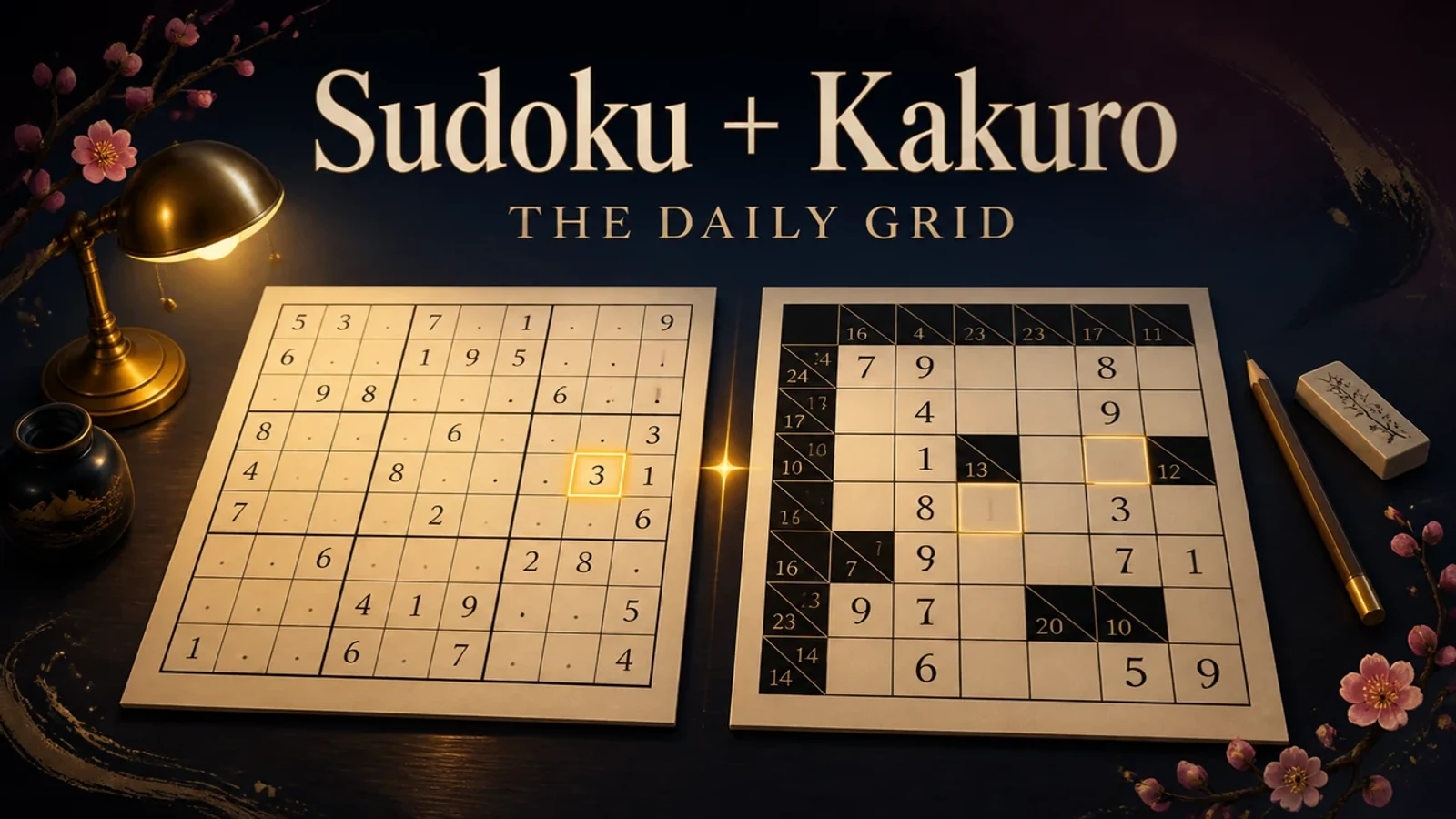
Sudoku + Kakuro: The Daily Grid is a premium Android logic puzzle game developed by Fire Dragon Interactive and published by Snack Break Games. It combines Sudoku and Kakuro, offers generated puzzles and is available for $1.99. The Android version is advertised as playable offline without advertisements and supports Android 7 or newer.
| Game | Sudoku + Kakuro: The Daily Grid |
|---|---|
| Platform | Android |
| Developer | Fire Dragon Interactive |
| Publisher | Snack Break Games |
| Genre | Logic Puzzle |
| Price | $1.99 USD |
| Advertisements | None, according to the publisher |
| Offline gameplay | Supported, according to the publisher |
| Minimum Android version | Android 7 |
| Download size | Approximately 5 MB |
| Purchase method | Official website APK download |
| Official website | Snack Break Games |
Editorial Feature & Product Overview (Pending Hands-On Android Scoring)
Numerical scores remain unrated until hands-on testing on real Android hardware is completed. How our review scores work.
There comes a point in every mobile gamer's life when the prospect of collecting another seventeen varieties of magical currency, upgrading a mythical sword and watching a thirty-second advertisement featuring someone spectacularly failing to park a car becomes a little exhausting. Sometimes you just want to sit down, solve a puzzle and enjoy the quiet satisfaction of discovering that your brain still works.
Enter Sudoku + Kakuro: The Daily Grid, an Android puzzle game from Fire Dragon Interactive, published by Snack Break Games. For the princely sum of $1.99, it offers two classic number puzzles, a virtually inexhaustible supply of grids and a refreshing absence of advertisements. There are no dragons, no loot boxes and no suspiciously enthusiastic character demanding that you return every four hours to collect your vegetables.
There are, however, numbers. Quite a lot of them. And some of them are going to make you question your educational background.
Sudoku: The Old Familiar Enemy
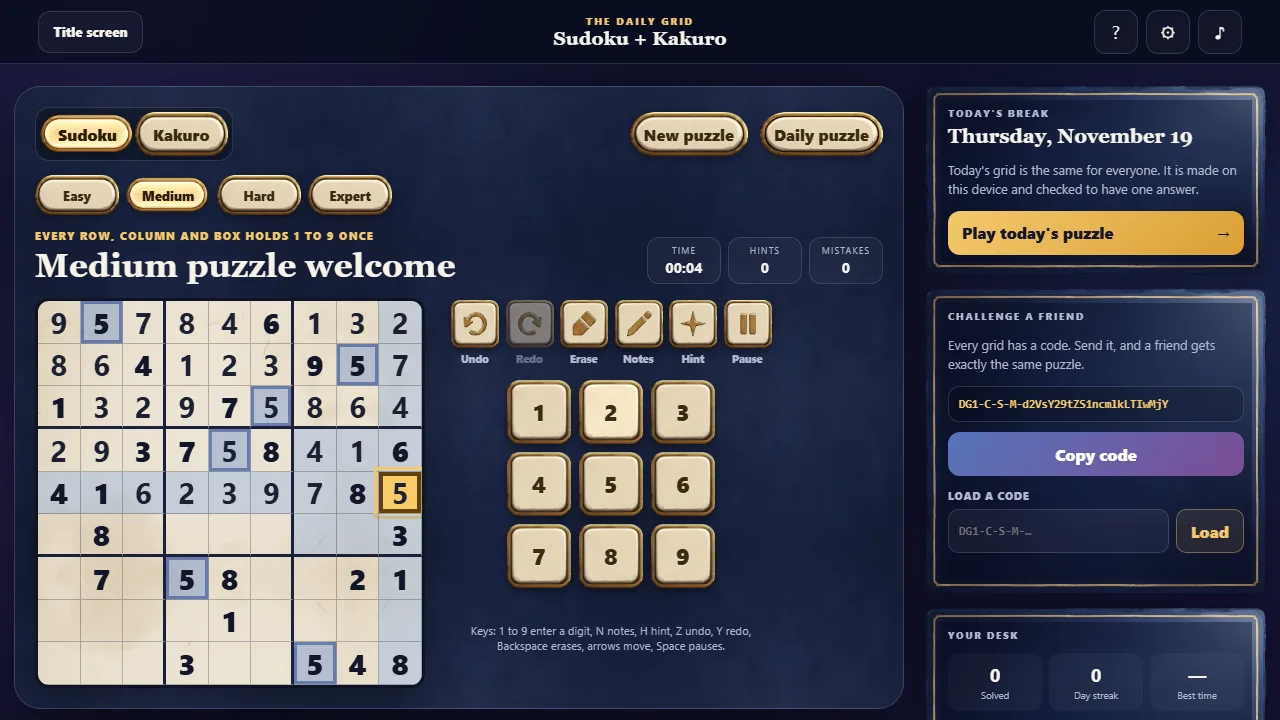
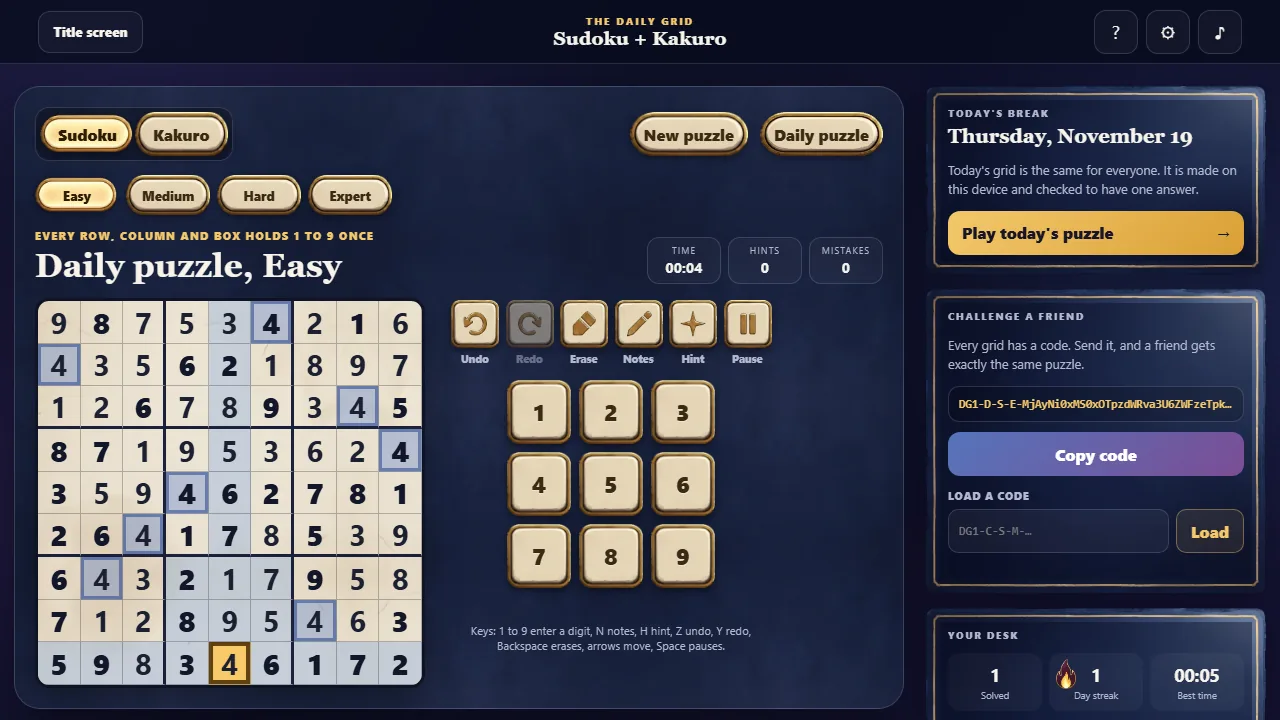
Sudoku hardly needs an introduction. You have a nine-by-nine grid, a selection of conveniently pre-filled numbers and the seemingly straightforward task of placing the digits one through nine without repeating them in any row, column or three-by-three box.
Simple, right?
That comforting illusion usually lasts until you reach a more difficult puzzle and find yourself staring at an empty square as though it personally owes you money. The wonderful thing about Sudoku is that its rules can be explained in thirty seconds, while its more demanding puzzles can keep perfectly intelligent adults occupied for considerably longer than they would care to admit.
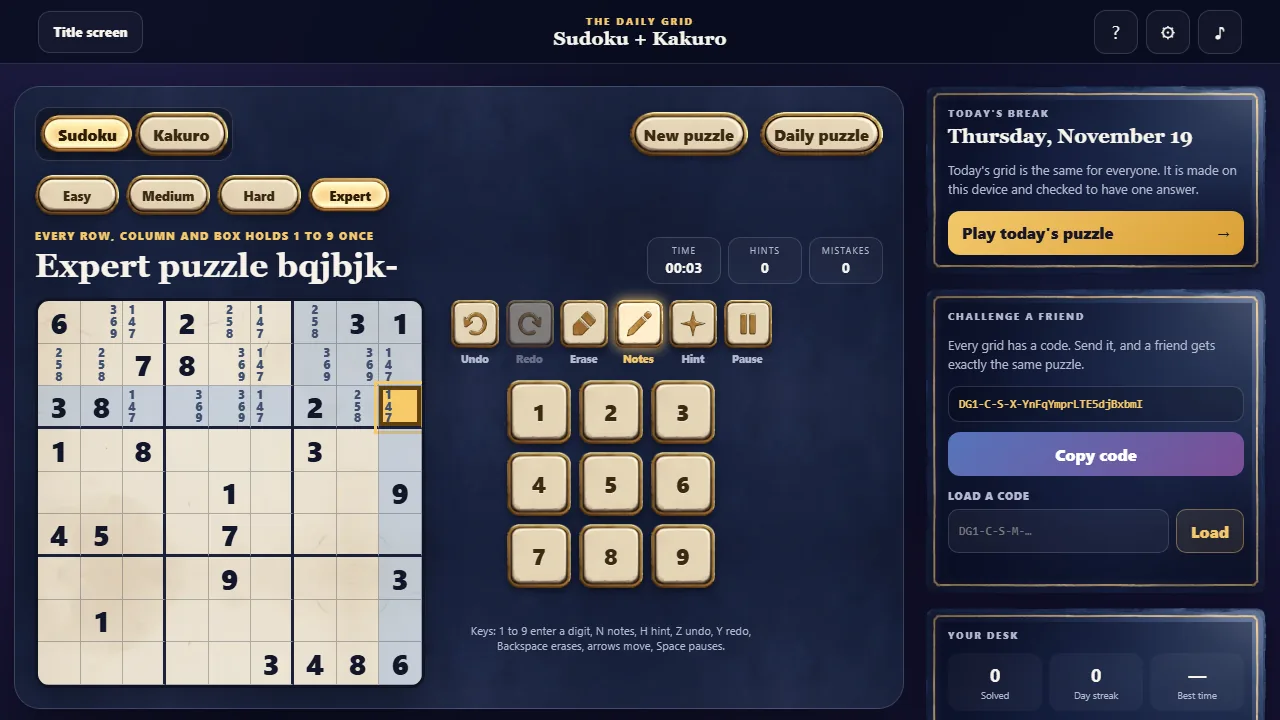
The Daily Grid offers four difficulty levels, allowing newcomers to get comfortable with the basics before graduating to puzzles that demand more advanced logical deductions. Rather than relying on a finite collection of boards, the game's design uses generated puzzles checked for a unique solution, providing a renewable supply of numerical challenges.
This matters because guessing your way through a badly designed Sudoku puzzle is about as satisfying as completing a crossword by writing whatever words fit. A properly constructed puzzle should reward deduction, and the promise of consistently solvable grids is one of the strongest aspects of The Daily Grid's design.
Kakuro: Sudoku's Slightly More Demanding Cousin
If Sudoku is the respectable family member who turns up on time for dinner, Kakuro is the eccentric cousin who arrives carrying a calculator and insists that everyone solve an arithmetic problem before being allowed dessert.
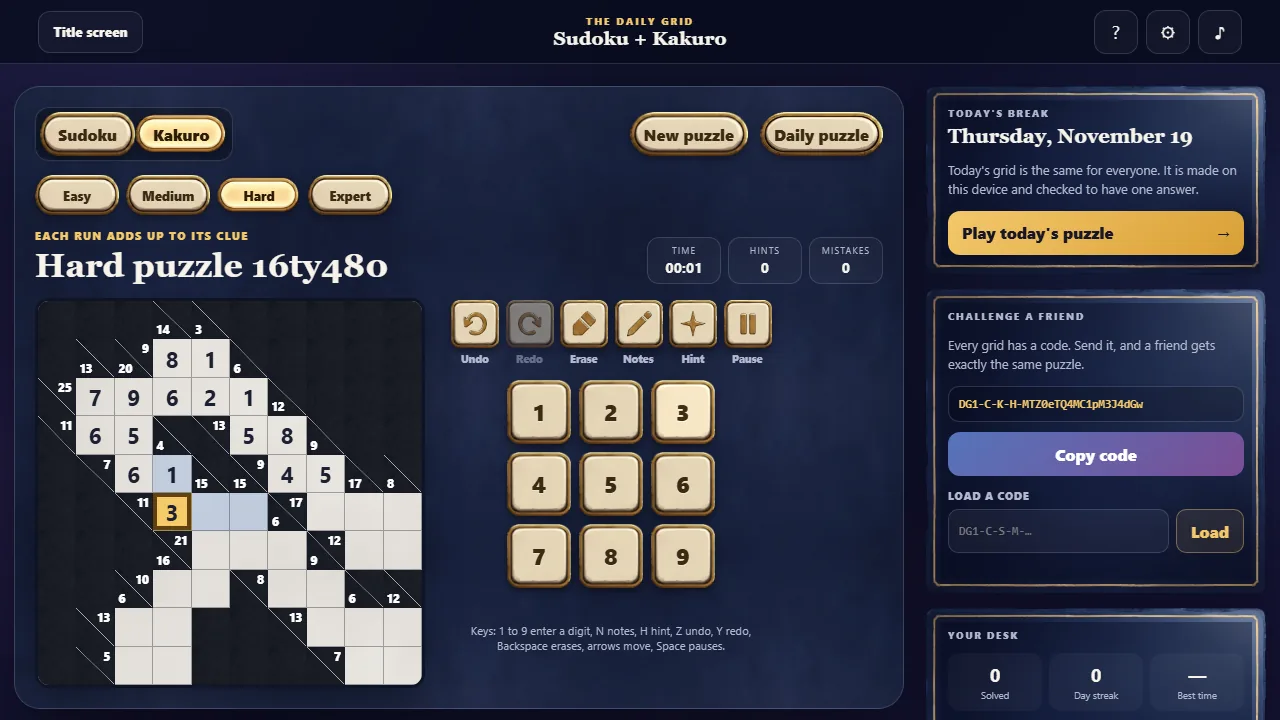
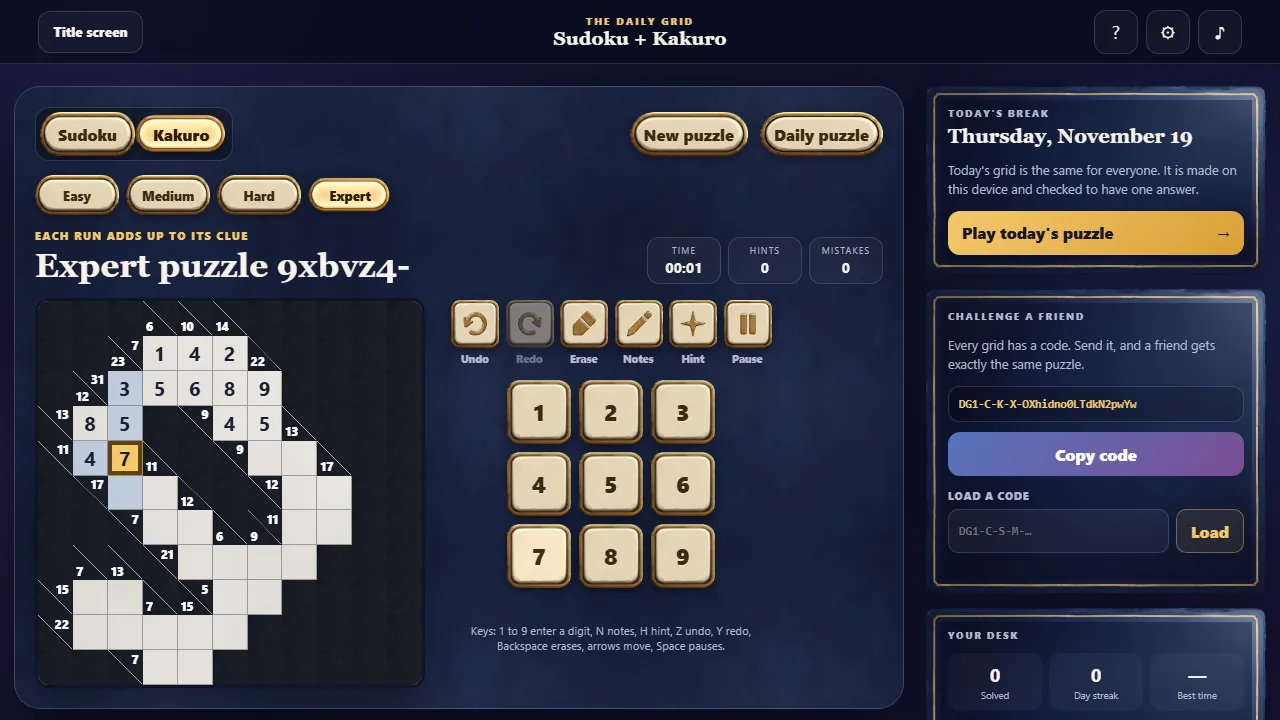
Kakuro combines elements of numerical logic with the structure of a crossword. Instead of filling a grid according to fixed rows, columns and boxes, players work with groups of empty cells and numerical clues indicating what the digits in each group must add up to. Digits cannot be repeated within an individual clue group, and intersecting sequences must satisfy their respective totals.
It sounds intimidating when explained on paper, but consider a simple example. If two cells need to add up to three, the only possible digits are one and two. Establishing which digit goes where depends on the intersecting clues. As more information becomes available, an initially intimidating board begins to unravel into a collection of increasingly manageable decisions.
Until, of course, you discover that something you confidently entered ten minutes earlier was completely wrong.
Kakuro is the feature that makes The Daily Grid considerably more interesting than another standalone Sudoku application. It offers a different style of reasoning, encouraging players to consider combinations and numerical relationships rather than concentrating exclusively on elimination.
The game's larger Kakuro boards reach eleven by eleven, according to the official product information, giving experienced puzzle enthusiasts something substantial to work towards. Anyone who considers Sudoku a comfortable routine may discover that Kakuro is where their ambitions encounter reality.
A Puzzle Game That Doesn't Interrupt Your Thinking
One of the most appealing aspects of The Daily Grid is its straightforward commercial proposition. You pay $1.99 for the Android edition and receive a game advertised as playable offline without advertisements.
That should not be particularly revolutionary. Unfortunately, the modern mobile gaming industry has spent years making it feel that way.
Few things are more irritating than finding yourself halfway through a particularly satisfying train of logical deduction, only for the screen to fill with an advertisement for a game involving a distressed king, rising lava and some inexplicably complicated plumbing.
Number puzzles benefit enormously from uninterrupted concentration. They are also ideal for situations where an internet connection is unreliable or simply unavailable. A flight, a train journey, a waiting room or an extended visit to a relative who insists on explaining their new garden shed all represent perfectly respectable opportunities for some discreet puzzle-solving.
The remarkably small advertised Android download, approximately 5 MB, is another welcome detail. In an era when some mobile games appear to require enough storage space to accommodate a small regional airport, The Daily Grid's modest footprint feels positively liberating.
Notes, Hints and the Art of Looking Intelligent
A good digital puzzle game needs to offer more than an attractive grid and a selection of numbers. Pencil notes, helpful highlighting and opportunities to correct mistakes are essential when puzzles become more demanding.
The Daily Grid's documented feature set includes candidate notes, hints, undo functionality and alternative visual themes. These are sensible additions because they reproduce many of the advantages of solving puzzles with a pencil and paper without requiring you to purchase an industrial quantity of erasers.
Pencil notes are particularly useful in advanced Sudoku and Kakuro puzzles, where several possible values may need to be considered before the correct answer becomes apparent. They allow players to work through possibilities systematically rather than entering numbers with the reckless optimism of someone purchasing cryptocurrency after reading a social media post.
Optional hints are similarly important. Nobody enjoys being permanently stuck, and a well-designed hint should help players understand the next step rather than simply completing the puzzle on their behalf. The availability of assistance also makes a game like this more approachable for anyone encountering Kakuro for the first time.
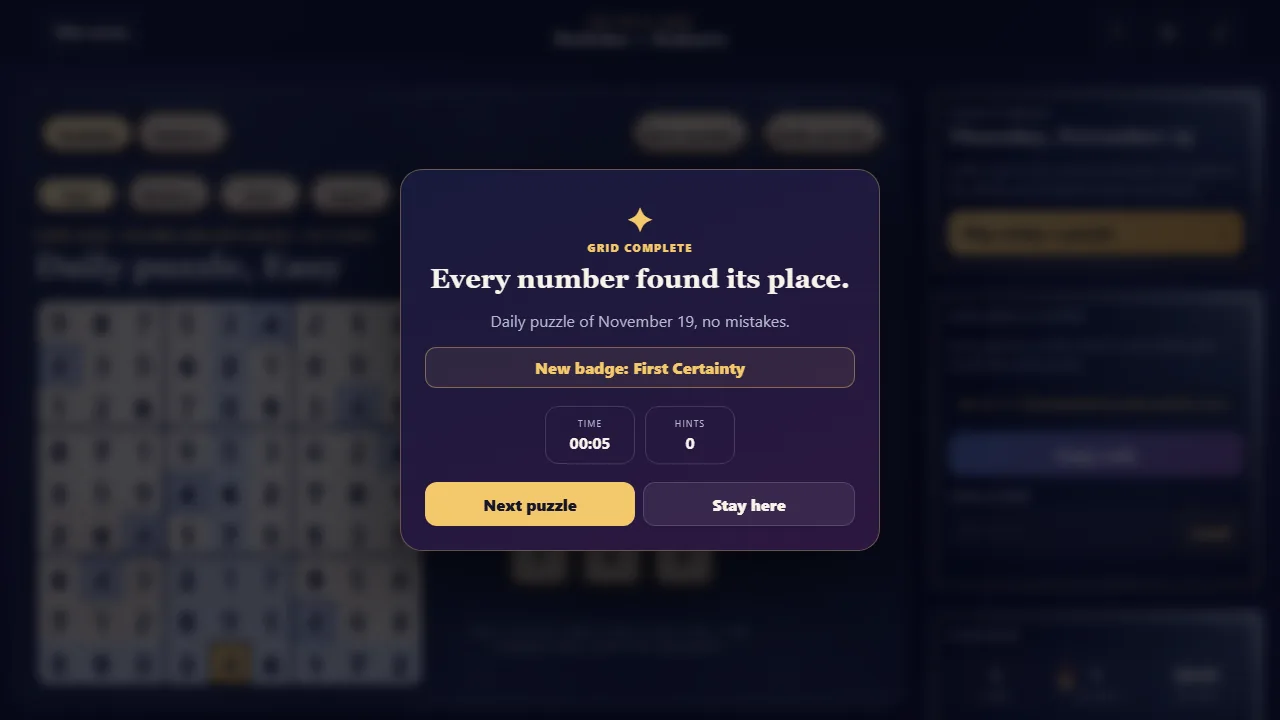
For competitive puzzle enthusiasts, daily challenges, puzzle-sharing codes and achievement systems provide additional reasons to return. There is something particularly entertaining about sending a difficult puzzle to a friend and waiting to discover whether they solve it faster than you. Admittedly, the friendship may become slightly strained in the process.
Presentation: A Quiet Desk Rather Than a Las Vegas Casino
The visual identity of The Daily Grid revolves around a relaxed puzzle-solving environment. Its official imagery presents a dark blue desk, warm decorative details and clearly defined number grids rather than the relentless fireworks and brightly coloured rewards associated with many contemporary casual games.
This is an appropriate direction. A Sudoku application does not need an elaborate cinematic sequence every time someone correctly places a seven. Nor does it need an animated treasure chest, a dancing mascot or a notification explaining that the player has achieved an outstanding level of numerical magnificence.
What matters is readability. Numbers need to be distinguishable, selected cells should be obvious and important clues must remain visible even on smaller smartphone displays. The documented options for alternative colour schemes and visual feedback are therefore more significant than graphical spectacle.
The same applies to audio. A logic game should complement concentration rather than provide a soundtrack that makes players feel as though they are defusing a nuclear reactor. The advertised design includes separate audio controls, a sensible feature for players who prefer silence while contemplating the increasingly questionable placement of a nine.
As with any mobile puzzle game, the quality of the Android implementation ultimately depends on how comfortably its interface translates to a touchscreen, particularly on the larger Kakuro boards.
A Daily Challenge Without a Second Job
Daily challenges are a natural fit for number puzzles. Completing one over breakfast or during a lunch break provides a small, measurable sense of achievement without demanding an entire evening of your time.
The Daily Grid's generated puzzles also mean that players are not restricted to waiting for the next daily challenge. Those who finish a board and immediately decide that their brain deserves further punishment can simply request another.
This is where the combination of Sudoku and Kakuro works especially well. When one style of reasoning starts becoming repetitive, switching to the other changes the mental challenge without requiring a completely different game.
There is no sprawling campaign, elaborate narrative or collection of unlockable fantasy characters. Players looking for constant visual rewards and dramatic progression systems may find the experience rather restrained. Its appeal instead lies in mastering increasingly demanding puzzles and enjoying the satisfaction of a correctly completed board.
It is a digital puzzle book in the best sense of the term: compact, reusable and considerably less likely to end up underneath a pile of unread magazines.
Buying and Installing the Android Edition
There is one important difference between The Daily Grid and most Android games covered by Gameforce Mobile. The Android edition is sold directly through Snack Break Games as an APK download rather than being presented as a Google Play purchase.
Customers should visit the official Sudoku + Kakuro: The Daily Grid product page, select the Android edition and follow the purchase and installation instructions provided by the publisher. Android may request permission to install an application from the browser used to download it.
Only download the APK from the official website, leave normal Android security protections enabled and revoke temporary installation permissions afterwards if they are no longer needed.
The direct distribution approach is slightly less convenient than pressing an Install button in Google Play, particularly for people unfamiliar with installing APK files. Nevertheless, it provides a clear alternative for a small premium game with no ongoing subscription.
At $1.99, the financial commitment is modest. The publisher also offers a browser demo of the game for anyone who wants to explore its general puzzle mechanics before purchasing, although the browser demo should not be confused with the full Android application.
The Gameforce Mobile Verdict
Sudoku + Kakuro: The Daily Grid represents an increasingly welcome proposition in mobile gaming: a small game that knows precisely what it wants to be.
Combining two established logic puzzles provides more variety than a conventional Sudoku application, while the generated grids, multiple difficulty levels and daily challenges give the concept genuine long-term appeal. Its low price, advertised offline functionality and absence of advertisements make it particularly attractive to players who prefer purchasing a complete game rather than entering into a long-term financial relationship with a mobile application.
Its limitations are equally clear. This is a traditional number-puzzle collection rather than a reinvention of the genre, the direct APK installation adds an extra step and larger puzzles may demand more patience from both the player and their smartphone's screen.
For fans of Sudoku, Kakuro, crosswords and other thoughtful games, however, there is a compelling simplicity to the package. It offers the prospect of countless satisfying little victories, interrupted only by the occasional discovery that your supposedly flawless reasoning was fundamentally incorrect.
And unlike many modern mobile games, it will not ask you to purchase a premium battle pass to recover from that discovery.
If you enjoy thoughtful, self-contained mobile games without intrusive monetization, you can also explore our Monument Valley review, browse all mobile game reviews, or catch up on the latest Android game news and daily mobile gaming wire.
Game Screenshots
Pros
- Two classic logic games in one application.
- Generated puzzles with substantial replay potential.
- Four difficulty levels for each puzzle type.
- Affordable one-time purchase.
- Advertised offline gameplay.
- No advertisements according to the official listing.
- Extremely small Android download.
- Daily puzzles and useful solving tools.
Cons
- Direct APK installation is less convenient than conventional app-store installation.
- Traditional puzzle mechanics may not appeal to players seeking greater variety.
- Larger Kakuro grids may be demanding on small smartphone screens.
- Limited appeal for players who dislike number-based logic puzzles.
Editorial disclosure: Gameforce Mobile and Snack Break Games are affiliated through common ownership. This relationship is disclosed so readers can evaluate the coverage accordingly. Product information and editorial assessments must remain accurate and transparent.
Frequently Asked Questions
Is Sudoku + Kakuro: The Daily Grid available for Android?
Yes. The Android edition is available directly through Snack Break Games as an APK download.
How much does Sudoku + Kakuro cost on Android?
The Android version costs US$1.99 as a one-time purchase. Local taxes or currency conversion may affect the final checkout total.
Does Sudoku + Kakuro contain advertisements?
The official Android listing states that the application does not contain advertisements.
Can I play Sudoku + Kakuro without an internet connection?
Yes, according to the publisher. Internet access is required to purchase and download the application, but installed gameplay supports offline use.
What is the difference between Sudoku and Kakuro?
Sudoku requires players to arrange digits without repetition in rows, columns and designated boxes. Kakuro uses intersecting groups of cells whose digits must add up to specified numerical clues.
Does the game offer unlimited puzzles?
The game's documented design generates new puzzles rather than relying exclusively on a fixed puzzle collection.
Which Android version is required?
The official product listing specifies Android 7 or newer.
How large is the Android download?
Approximately 5 MB, according to the official listing.
Where can I buy Sudoku + Kakuro for Android?
Purchase the Android edition directly from the official product page at https://www.snackbreakgames.com/games/sudoku-kakuro/ and select the Android purchase option.
Is Sudoku + Kakuro suitable for beginners?
The game's documented four-level difficulty system and solving assistance make it suitable in concept for newcomers as well as experienced puzzle enthusiasts.


