Hardware & Retro /
MediaTek prepares 2nm Dimensity 9600 launch for September 15
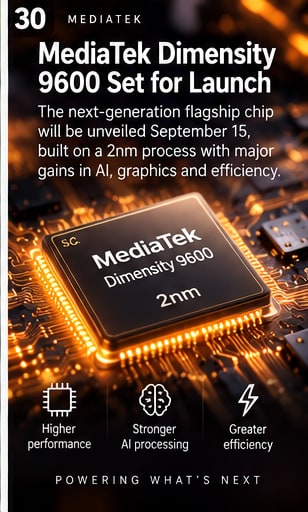
MediaTek is expected to unveil its next flagship Dimensity 9600 family on September 15, placing the mobile silicon industry on the eve of another major perfo...
Key facts
- Topic:
- Hardware & Retro
- Published:
- 2026-09-14
- Reported by:
- Gameforce Mobile News Desk
Key takeaways
- MediaTek is expected to unveil its next flagship Dimensity 9600 family on September 15, placing the mobile silicon industry on the eve of another major performance cycle.
- The chip is widely expected to be among the first smartphone platforms manufactured using a 2nm process, with improvements aimed at AI processing, graphics and power efficiency.
- Shrinking transistor processes does not automatically guarantee better devices, but efficiency is particularly valuable on phones because battery capacity and heat dissipation are tightly constrained.
MediaTek is expected to unveil its next flagship Dimensity 9600 family on September 15, placing the mobile silicon industry on the eve of another major performance cycle. The chip is widely expected to be among the first smartphone platforms manufactured using a 2nm process, with improvements aimed at AI processing, graphics and power efficiency.
Shrinking transistor processes does not automatically guarantee better devices, but efficiency is particularly valuable on phones because battery capacity and heat dissipation are tightly constrained. A processor that accomplishes the same work using less power can sustain gaming performance longer and spend more time running local AI without overheating. MediaTek has steadily moved from being associated primarily with value-oriented Android phones to competing directly in the premium segment.
The Dimensity 9600 launch therefore matters beyond benchmark enthusiasts: stronger competition at the flagship level pressures Qualcomm and device manufacturers to improve performance while controlling chip costs and power consumption.